Blessed are the Pure in Heart: Muslims, Ritual Purity, and the Gospel

The Wudu area inside of Badshahi Mosque in Lahore Pakistan. Visitors are seated to perform their ablutions before praying in the mosque,. https://en.wikipedia.org/wiki/Image:People_washing_up_to_pray_at_badshahi_mosque.JPG

Muslims tend to be obsessed with ritual purity. Islam demands this obsession for the person who wants God to hear their prayers. This blog post aims to explain this obsession and discuss the implications of this obsession for sharing the gospel with Muslims. I believe that understanding and framing Scripture in terms of purity issues is cultural key that will help most Muslim workers communicate the Bible well to their Muslim friends. Please note that I am writing from a South Asian context. It is possible that these cultural issues will differ from place to place.

This blog post is lengthy. The reason is that concepts of purity in the Bible and the Qur’an are complex. In fact, I honestly feel like this article is too short to do justice to the issues involved. I have omitted quite a bit to keep this to a readable length.

Since this blog post will be longer than most, here is the outline:

  • Part 1: Islamic Regulations Regarding Ritual Purity
  • Part 2: The Law of Moses and Ritual Purity
  • Part 3: The New Covenant and Ritual Purity
  • Part 4: Baptism, the Holy Spirit, and Ritual Purity
  • Part 5: Sharing the Gospel and Ritual Purity (the most practical section)
  • Part 6: The Sermon on the Mount and Ritual Purity (the second most practical section)

PART 1: ISLAMIC REGULATIONS REGARDING RITUAL PURITY

Probably the best way to understand the issue of ritual purity in Islam is to study its regulations regarding wudu and ghusl. Wudu is a partial washing, whereas ghusl is a complete washing. Muslims generally perform Wudu before prayers at a mosque. Ghusl is a full bath taken in the privacy of one’s home.

In general, wudu begins when a Muslim intends in their heart to become ritually pure through an act of cleansing. Then in this order, they (1) wash their face, (2) wash their arms from the fingertips to the elbows, (3) wipe their head and (4) wash both feet up to the ankles. Washing the face includes gargling water and sniffing water into the nostrils to clean these. There are slight differences in how different sects perform wudu. 

You might be asking, “Why is ritual purity important for a Muslim?” This is a great question. Perhaps the two most important things that someone cannot do while they are impure/unsanctified are (1) pray and (2) read or recite the Qur’an. First, a person must become ritually pure; then, they can pray and study the Qur’an. An impure person is not permitted to come close to God in Islam. 

Wudu and Ghusl are required whenever someone becomes ritually impure. Here are a few particulars of what this means:

  • Going to the bathroom (urination or defecation) and passing gas makes someone ritually impure. These all require wudu to become ritually pure. 
  • One of the most interesting fatwas[1] I read recently was a man asking for guidance regarding issues passing gas. He has so much trouble passing gas that he could not finish wudu without passing gas. As a result, he could never become ritually pure. Thus he had a fear that all his prayers would be invalid. If he could not become ritually pure, then he could not pray. If he could not pray, then what would he do? You could feel this man’s franticness in his question.[2]
  • Sex makes someone ritually impure. However, sex requires the full ghusl rather than a simple wudu to become ritually pure. Suppose someone performs ghusl with an intention for worship to become ritually pure and includes the wudu as part of the ghusl. In that case, wudu is not required after ghusl. However, many perform ghusl and then wudu to become pure again. 
  • Islamic sites are full of detailed rules on exactly what kind of sex makes someone impure and what does not break purity. There are disagreements among Muslim scholars on some of the detailed issues. To followers of Jesus, it is strange to read Islamic scholars discussing sexual acts in the detail that they do to determine precisely when ritual purity is broken. But such is the curse of any system where ritually purity is obtained through rituals. 
  • Most Muslims believe that someone simply touching their (or any) penis makes someone ritually impure. However, merely touching a penis only requires wudu to regain purity.
  • Menstruation and post-natal bleeding make someone ritually impure. Therefore, a woman cannot become ritually pure during her monthly menstrual cycle. It seems to me that one implication is that a woman cannot have her prayers heard during her monthly cycle. Ghusl is required to attain ritual purity at the end of the menstrual cycle. 

The rules on ritual purity are more complex and detailed than what I have written above. Different schools have different opinions, but these are true in general. To summarize, Muslims cannot pray unless they are ritually pure. According to Islam, Muslims become ritually pure through the washing rituals of wudu and ghusl. 

Here are four additional anecdotes to illustrate the importance of purity in the lives of Muslims.

  1. Muslim men often squat to urinate because of purity rules. The reason is that a Muslim’s clothes must also be ritually pure for them to be able to pray. When a man urinates, if even a drop of urine splatters on his pants, his pants are unclean and cannot be worn for prayers. 
  2. Pakistan means “the land of the pure.” This name reveals much about the felt needs of Muslims in South Asia! Before the Partition of India and Pakistan, Muslims often fretted about how to live as Muslims while under non-Muslim rule properly. For them, it was natural to break away from the British and Hindus to make a land characterized by ritual purity.
  3. During the Covid pandemic, Muslims fretted about Covid regulations related to ritual purity. For example, alcohol is haram (forbidden) in Islam. Therefore, many Muslims asked whether alcohol-based hand sanitizers were also haram and whether they would make them impure and invalidate their prayers. Muslims asked a similar question about whether using alcohol-based cleaners to clean a mosque facility would make the entire mosque unclean. A third concern was whether Covid testing, which required swabs to enter the nose and mouth, would invalidate a fast. Muslims are not permitted to have anything enter their nose or mouth during a fast. 
  4. I recently read an anecdote about Imam Abu Hanifa (who holds importance among Sunni Muslims similar to Martin Luther among Protestants). It said, “For forty years he said his morning prayers with the wudu he had performed for his isha prayer (the night prayer).”[3] This claim is that Hanifa guarded his ritual purity so carefully that he did not make love to his wife, go to the bathroom, pass gas, or do anything else to break impurity from the evening to the morning for forty years. While the accuracy of this anecdote is unlikely, it illustrates the importance of ritual purity in the life of Muslims.

PART 2: THE LAW OF MOSES AND RITUAL PURITY

As followers of Jesus, we should ask how these rules in Islam relate to the Bible. We will address this question in multiple parts. First, we will look at ritual purity in the Law of Moses, which Muslims call the Taurat Sharif. Then we will look at the ritual purity in the New Testament, which Muslims call the Injeel Sharif.

The Law of Moses contains regulations similar (but not identical) to those in Islam. The book of Leviticus, in particular, is full of these kinds of rules. Here are some examples:[4]

  • “If one of the animals that you use for food dies, anyone who touches its carcass will be unclean until evening. Anyone who eats some of its carcass is to wash his clothes and will be unclean until evening. Anyone who carries its carcass must wash his clothes and will be unclean until evening.” Leviticus 11:39-40
  • “When a woman becomes pregnant and gives birth to a male child, she will be unclean seven days, as she is during the days of her menstrual impurity.” Leviticus 12:2b
  • “The person who has a case of serious skin disease is to have his clothes torn and his hair hanging loose, and he must cover his mouth and cry out, ‘Unclean, unclean!’ He will remain unclean as long as he has the disease; he is unclean. He must live alone in a place outside the camp.” Leviticus 13:45-46
  • “When a man has an emission of semen, he is to bathe himself completely with water, and he will remain unclean until evening. Any clothing or leather on which there is an emission of semen is to be washed with water, and it will remain unclean until evening. If a man sleeps with a woman and has an emission of semen, both of them are to bathe with water, and they will remain unclean until evening.” Leviticus 15:16-18

Indeed, the issue of ritual purity is present in the Law of Moses. Many of these rules are like those in Islam. However, the Law of Moses is even stricter. For example, if a man and woman have sex, even after bathing, their impurity would last until the evening (Lev 15:18). In contrast, according to Islam, ghusl removes the impurity immediately. Significantly, there is not a one-to-one correlation of purity rules between the Law of Moses and the Qur’an because it is one indication (of many) of discontinuity between these books.[5]

The results of impurity in the Law of Moses are significant. Here are a few verses about the consequences of ritual impurity:

  • “You must keep the Israelites from their uncleanness, so that they do not die by defiling my tabernacle that is among them.” Leviticus 15:31
  • “Be holy because I, the Lord your God, am holy.” Leviticus 19:2b
  • “Anyone who touches a body of a person who has died, and does not purify himself, defiles the Tabernacle of the Lord. That person will be cut off from Israel.” Numbers 19:13

In simple terms, a person could not worship God in the Law of Moses when they were ritually impure. If they broke the purity laws, they would be exiled from God’s people. 

Later, the prophets declared the curse of God on the people of Israel using terms of ritual impurity. For example, Ezekiel wrote, “’Therefore, as I live’ – this is the declaration of the Lord God – ‘I will withdraw and show you no pity, because you have defiled my sanctuary with all of your abhorrent acts and detestable practices’” (Ezek 5:11). In this verse, God declared His intention to judge His people because of their ritual impurity, i.e., because they defiled God’s sanctuary.

Here are four things we can learn from the focus on ritual purity in the Old Testament:

  1. God is holy. He wants His people to be holy. Sometimes, I think that Christians have lost a focus on personal holiness. The reason is because of the emphasis against hypocrisy in the New Testament. However, Scripture shows that God desires His people to be holy both inside and out. The answer to hypocrisy, which we will discuss below, is not to abandon holiness but to pursue the kind of holiness taught in the Sermon on the Mount (Matthew 5-7) that is both internal and external.
  2. The laws regulating ritual purity in Islam have similarities to the Law of Moses. Therefore, one way to look at Islam is that it is an attempt to return to the system that was in place before Jesus died on the cross for our sins, ascended to heaven, and gave us the Holy Spirit. 
  3. Even more, Islamic law conflicts with the Law of Moses. While Islamic law relating to purity has similarities to the Law of Moses, the details are different. These are two different sets of laws regarding ritual purity. Since there are differences in details, these two systems conflict, so the reader must determine one of three options. The first option is that both systems are false. The second option is that the Law of Moses is true, and the Qur’an is false. The third option is that the Qur’an is true, and the Law of Moses is false. As a follower of Jesus, I believe the second option is correct. What I mean is that I think that the Law of Moses is true and that the Qur’an is false. Muslims have no good options here. Their preferable choice is the third option, but the Qur’an testifies that the Qur’an and the Law of Moses are not in conflict (see, for example, Qur’an 5:44-48). Muslims have tried to explain this by saying that the Law of Moses has been corrupted, which is an unsatisfying answer for many reasons. In the end, the conflict between the Law of Moses and the Qur’an is one indication that the Qur’an is not from God.
  4. Both Islam and historic Judaism strongly emphasize ritual purity related to worship.

PART 3: THE NEW COVENANT AND RITUAL PURITY

One of the great truths of the New Covenant is that the sacrifice of our Lord Jesus freed us from the regulations of ritual purity of the Law of Moses. There are many places in the New Testament where we could demonstrate this truth. Here we will look briefly at Galatians.

In the book of Galatians, the Law of Moses is described as a temporary guardian (Greek pedagogue) to watch over us until the fullness came in Jesus. Before the Law of Moses, God made a promise with Abraham, including the promise that “All the nations will be blessed in you” (Genesis 12:3; Galatians 3:8). God chose Abraham from among the nations and made a covenant with him that He would make his name great and make him into a great nation (Genesis 12:1-3; 15:1-21, etc.). The point is that this promise from God to Abraham came 430 years before God gave the Law to Moses (Galatians 3:17). 

From Galatians 3:15-26, I want to explain the relationship of God’s Promise to Abraham to the Law of Moses and how this relates to the Gospel of Jesus. 

  • “Brothers and sisters, I’m using a human illustration. No one sets aside or makes additions to a validated human will” (Gal 3:15). The point here is that once a promise is made, it cannot be changed. God made a promise to Abraham. Therefore, rules given after the Promise to Abraham cannot alter or invalidate that Promise.
  • “Now the promises were spoken to Abraham and to his seed. He does not say “and to seeds,” as though referring to many, but referring to one, and to your seed, who is Christ” (Gal 3:16). Throughout the Law of Moses (Genesis to Deuteronomy), there are numerous references to the Seed of Abraham. The meaning of this verse is that Jesus is the natural successor of these references. Jesus is the successor of the Promise that God gave through Abraham (see also Galatians 3:8).
  • My point is this: The law, which came 430 years later, does not invalidate a covenant previously established by God and thus cancel the promise” (Gal 3:17). God made a covenant with Abraham, then 430 years later gave the Law through Moses. Since the Promise precedes the Law, the Law cannot cancel the Promise. This argument is legal reasoning that a promise or covenant cannot be changed.
  • For if the inheritance is based on the law, it is no longer based on the promise; but God has graciously given it to Abraham through the promise” (Gal 3:18). This verse simply provides further clarification. The inheritance is either based on either the Promise or the Law. The inheritance means being the people of God in this passage. Since the Promise came first, the Law, which came later, cannot abrogate it. Therefore, the gospel of Jesus stands firmly on the promise God gave to Abraham and is a continuation of that promise. 
  • “Why, then, was the law given? It was added for the sake of transgressions until the Seed to whom the promise was made would come” (Gal 3:19a). Since the Law of Moses does not provide salvation, but rather the promise God gave Abraham does, the natural question is, “Why, then, was the law given?” The answer is that God gave it to restrain sin in the people of God until the coming of the promised Seed, who is Jesus. Therefore, the Law of Moses was a temporary restraint placed upon God’s people to keep them from sinning before Jesus.
  • “Is the law therefore contrary to God’s promises? Absolutely not! For if the law had been granted with the ability to give life, then righteousness would certainly be on the basis of the law” (Gal 3:21). The Law of Moses was the most perfect law that could be given (see Rom 7:12). It was not against the promises of God. Indeed, if a law could give life, then that law would have been the one able to do so. As Galatians clarifies, the new system under Jesus is that He purified His people through His sacrificial death and then gave them the Holy Spirit. So, now God’s people do not become holy by adhering to the Law. Instead, they become holy by the guidance and power of God’s Spirit. The primary difference between these two systems is that the Law of Moses was a perfect system of rules. However, followers of Jesus today walk into holiness by the power of God living in us. 
  • “But the Scripture imprisoned everything under sin’s power, so that the promise might be given on the basis of faith in Jesus Christ to those who believe. 23 Before this faith came, we were confined under the law, imprisoned until the coming faith was revealed” (Gal 3:22-23). In verse 22, “the Scripture” that has imprisoned everything under sin’s power is the Law of Moses. When we read the Law and seek to obey it completely, we realize our sin and inability to draw close to God (see Galatians 3:10-14). Being confined under the Law of Moses only occurred until Jesus came.
  •  “The law, then, was our guardian (Greek pedagogue) until Christ, so that we could be justified by faith” (Gal 3:24). The Greek word pedagogue here is one of my favorites. We do not have an exact term in English for a pedagogue. So, some people have used “teacher” or “guardian” to try to translate this idea. However, a pedagogue in ancient Rome was an enslaved person assigned by a landowner to look over their children. More than anything, the job of a pedagogue was to discipline the child into obedience.[6] The Law of Moses was to serve as a pedagogue for the people of God. As a pedagogue disciplined children for the landowner, the Law of Moses disciplined God’s people for God. The function of the Law of Moses as a pedagogue had a time limit, “until Christ.” Therefore, when Jesus Christ came, the Law of Moses no longer served as a pedagogue.
  •  “But since that faith has come, we are no longer under a guardian, 26 for through faith you are all sons of God in Christ Jesus” (Gal 3:25-26). Since Jesus has come, we are no longer under the control of the pedagogue of the Law. Instead, we have freedom from that Law and have gained maturity in Christ. 

Now, the astute reader of Galatians should be asking questions like, “If we are not under the Law of Moses, then what is the new law we are under?” Or, “Does this mean that we can do whatever we want?”

The answer to these questions is that God gave us His Holy Spirit (see Galatians 5:16-25). A key verse is, “But if you are led by the Spirit, you are not under the law” (Gal 5:18). This verse means that if an individual has the gift of the Holy Spirit and is led by God’s Spirit, he is no longer obligated to adhere to the Law of Moses. If the Spirit leads us, sin will automatically be removed from our lives (Gal 5:19-21). And God will transform our character by the Spirit (Gal 5:22-23). The gift of the Holy Spirit should make a follower of Jesus than those who follow Islamic law or the Law of Moses. Another way of saying this is that if someone claims to be a follower of Jesus, yet their life is not holy, then the Spirit of God is not leading them. If the Spirit is not leading them, they are not truly in Jesus. 

Therefore, followers of Jesus are free from the particular rules of the Law of Moses related to ritual purity. However, if the Spirit of God is in a follower of Jesus, then that follower of Jesus will live a pure and holy life.

Galatians urges followers of Jesus not to return to the yoke of slavery, which is the Law of Moses. “For freedom, Christ set us free. Stand firm then and don’t submit again to a yoke of slavery” (Gal 5:1). For a follower of Jesus, returning to the pedagogue of the Law would be to take on an unnecessary yoke of slavery. Instead, the Holy Spirit connects us to God and leads us into holiness. 

When a follower of Jesus looks at the Islamic system of ritual purity with its rules and regulations, they see two things. First, they see a system that is something like the Law of Moses. Submitting themselves to Islamic law would be to unnecessarily take on a yoke of slavery, from which Jesus gave us freedom. By nature of what Jesus did on the cross, followers of Jesus reject the yoke of slavery of Islamic law. Second, followers of Jesus know where to find the perfect Law. The Law of Moses is the ideal, God-given law. If there were ever a system of law that could lead us into purity, it would be the Law of Moses. However, it was ultimately unable to do so. Therefore, God sent Jesus into the world to die on the cross for our sins. God gave us His Spirit to dwell in us and guide us. In short, we have a better system. We have no need to return to any law to attain ritual purity. 

Part 4: Baptism, a Pure Heart, the Holy Spirit, and Ritual Purity

In the New Testament, baptism is the only purity ritual for followers of Jesus. Comparing the Islamic systems of wudu and ghusl with baptism provides a stark contrast.

First, baptism is a rite that occurs only once in the believer’s life. In contrast, wudu and ghusl are continual rites that Muslims perform to attempt to attain and maintain ritual purity.

Additionally, there are no actions or sins that invalidate baptism. In contrast, wudu is broken by going to the bathroom or passing gas. This contrast demonstrates that the effects of baptism are far more potent than the effects of wudu. Baptism as a rite is so mighty that it permanently makes a follower of Jesus ritually pure. 

In Urdu, Pak Ghusl is a term for baptism, which means “a holy bath.” The modified “Pak” is the word for holy or pure in Urdu. It distinguishes the Pak Ghusl from the ordinary ghusl that Muslims utilize. The Islamic ghusl claims to provide temporary purity, while the Pak Ghusl of Jesus cleanses a person for life. 

I have often wondered how early Jewish followers of Jesus struggled over this transition. As they realized their freedom from the old purity laws and rituals, surely they were struck by the power and simplicity of the purity they had in Jesus. One of the strongest statements for Jewish followers of Jesus is in the book of Hebrews. Hebrews 8 describes the New Covenant that Jesus made by His blood, then Hebrews 9-10 describe His last and greatest sacrifice for our sins. The application of that passage begins is in Hebrews 10:19-22,

Therefore, brothers and sisters, since we have boldness to enter the sanctuary through the blood of Jesus ​— ​ he has inaugurated for us a new and living way through the curtain (that is, through his flesh ) ​— ​ and since we have a great high priest over the house of God, let us draw near with a true heart in full assurance of faith, with our hearts sprinkled clean from an evil conscience and our bodies washed in pure water.” 

According to this passage, our hearts have been sprinkled clean from an evil conscience. Ultimately, this is the primary difference between the Pak Ghusl and the ritual washings of Islam. The rituals of Islam merely clean the outside, while the work of Jesus cleanses our hearts. 

Our Lord Jesus confronted the religious leaders of his day with this challenge, “Woe to you, scribes and Pharisees, hypocrites! You clean the outside of the cup and dish, but inside they are full of greed and self-indulgence. Blind Pharisee! First clean the inside of the cup, so that the outside of it may also become clean.”The point is that Jesus emphasized an inner purity that went beyond external rituals and washings. He taught us that we would automatically be externally clean if we were internally clean. These teachings on internal purity were common from Jesus (see Matthew 15:1-20). Jesus proclaimed, “Blessed are the pure in heart, for they will see God” (Matt 5:8). Purity of heart rather than external purity is the requirement to see God. Jesus accomplished the work of purifying our hearts by giving His life on the cross for our sins. Baptism (Pak Ghusl) is merely a symbol of that powerful work that Jesus accomplished for us.

The concept of a clean heart or conscience is common in the New Testament (1 Tim 1:5; 3:9; 2 Tim 1:3; 2:22; Heb 10:22; 1 Pet 1:22).[7] God changing the heart of his people was at the core of the Old Testament promises of what God would do for His people. For example, Ezekiel wrote, “I will give you a new heart and put a new spirit within you; I will remove your heart of stone and give you a heart of flesh” (Ezek 36:26). The purpose of God transforming the hearts of His people was to cause them to walk in obedience to Him. The change of heart accompanies God giving His Spirit to His people in these Old Testament texts. 

The purifying power of the blood of Jesus is what prepared us for the Spirit of God. In the Old Testament, God had Moses prepare a tabernacle, which was the place for His presence to dwell (Exodus 25-40). When the people of God prepared the Tabernacle and all its components, God gave His people His regulations about sacrifice (Lev 1-7). Hebrews 9:22 summarizes those regulations well, “According to the law almost everything is purified with blood, and without the shedding of blood there is no forgiveness.” The Law of Moses provided two purposes for sacrifice. First, sacrifice provided for ritual purity. Likewise, we as followers of Jesus have been sprinkled clean by the blood of Jesus (1 Peter 1:2). Second, sacrifice provided for the forgiveness of sins. Throughout Leviticus 1-7, the person bringing the sacrifice would put his hands on the head of the animal as the priest sacrificed it for that person’s forgiveness. God gave this regulation in the Law of Moses to teach His people the depth of their sin and what was required for forgiveness. This system of sacrifice was a constant reminder to God’s people of their need to transfer their own guilt onto the animal as a sacrifice for their sins. The same picture is accurate of us in how Jesus took on our sins. As John the Baptist declared, “Behold, the lamb of God, who takes away the sins of the world!” (John 1:29)

In the Old Testament, the Tabernacle was where God would dwell among His people. So, they performed many sacrifices to purify the Tabernacle and priesthood in Leviticus 8-9. Leviticus 9:24 shares how this time of worship concluded. “Fire came from the Lord and consumed the burnt offering and the fat portions on the altar. And when all the people saw it, they shouted and fell facedown.” This verse describes God coming to dwell in the Tabernacle. It was necessary to make the Tabernacle holy through these sacrifices so that the presence of God could live there. 

Of course, there is a strong New Testament parallel. Today, followers of Jesus are called the temple of the Holy Spirit (1 Cor 3:16; 6:19; 2 Cor 6:16; Eph 2:21).[8] God poured His Holy Spirit on His people only after Jesus purified us by His blood. The old system of the Law of Moses could never sufficiently purify our hearts to make us ready for the Holy Spirit to dwell inside of us. But now, we have been prepared by the powerful work of Jesus on the cross. 

When we compare the New Testament system of purity and what Jesus did with the Islamic systems of wudu and ghusl, the Islamic systems are found to be lacking. There is great freedom in Jesus in which we are freed from constant washings and rituals to simply be with God by the indwelling power of His Spirit. God has given us this great gospel to share with our Muslim friends! The depths of these things can be challenging to explain initially. Still, the power of our freedom from constant purity rituals will be apparent to our Muslim friends. Because of our lack of purity rituals, their primary concern might be that we do not care about purity and holiness. 

In the same way that God freed the Jewish people from the Law of Moses through Jesus, God desires to free our Muslim neighbors from the burden of sharia law to know and obey Him.

PART 5: SHARING THE GOSPEL AND RITUAL PURITY

The previous sections provide theological foundations, these final two sections are practical guidance about how to utilize these theological truths in evangelism and discipleship. There are three ways that this teaching should influence our evangelism.

First, frame sin issues in terms of purity rather than only sin when sharing the gospel with Muslims.When we seek to argue about sin and our need for forgiveness, Muslims often say God is merciful and forgiving. They say that we simply need to ask for forgiveness and that no sacrifice is needed. Many have found themselves deep in theological arguments with Muslims about the necessity of substitutionary atonement. Some followers of Jesus have been frustrated that their Muslim friends do not see the depths of their sin.

On the other hand, some Muslims have mocked our beliefs on substitutionary atonement. They think it is impossible that Jesus could die for the sins of the world.

 Remember that God gave His people the picture of substitutionary atonement for over a thousand years. Under the Law of Moses, they brought a sacrificial animal whenever a person sinned. The sinner put their hands on the head of the animal and watched the priest make the sacrifice. God discipled His people to see and understand substitutionary atonement. 

I have found far less argument when I frame our need as purity rather than forgiveness. Every day, Muslims seek purity. If they are religious, they do a hundred small things every day to avoid becoming ritually impure or to become ritually pure. If they are more secular, half of their complaints are all the rituals related to purity!

I simply share something like this. “The God who made this world and all things in it is holy. However, when we look at humanity around us, everyone is impure. Can those who are impure go into the presence of God? It can never be. Every day, people work hard to become pure. But the problem is that we are not pure within. Jesus taught, “Blessed are the pure in heart, for they will see God.” The only way to see God is to have a pure heart! All the washing and cleaning rituals can clean our outside, but they can never clean our hearts.” 

It is my experience that when I frame our sin problem in this way that Muslims understand much more and are more willing and open to see the problem in their own life. 

Second, frame the gospel in heart issues rather than external purity. In the example above, I already shared an example of how I begin to speak to heart issues. Many Muslims are experts at being like Pharisees and showing their religious deeds to others. We need to learn how to talk to their hearts. I love attacking hypocrisy when I have gospel conversations with Muslims because it helps me get to heart issues. One way to define hypocrisy is simply being better at showing others you are religious or spiritual than you are in private. 

Try to describe your relationship with Jesus and how you experience Him to your Muslim friend. Model prayer in front of them as a picture of your relationship with God. For many Muslims, our relational style of worship to God is powerful. Share about specific ways that Jesus has transformed your character or comforted you. Help your Muslim friend see the reality of your faith. Throughout all of this, I love discussing Matthew 5:8 and Matthew 23:25-26. These two passages are favorites for getting to heart issues.

“Blessed are the pure in heart for they will see God.” Matthew 5:8

“Woe to you, scribes and Pharisees, hypocrites! You clean the outside of the cup and dish, but inside they are full of greed and self-indulgence. Blind Pharisee! First clean the inside of the cup, so that the outside of it may also become clean.” Matthew 23:25-26

Third, since we do not have a system of laws, some Muslims are very confused about what followers of Jesus are supposed to do. Many Muslims are very proud of their elaborate systems of rules and regulations. They only know a fraction of those rules and regulations, but they are proud that they are there. In contrast, Muslims see Christians as antinomians (those without laws) who commit every sin they want. In their minds, Christians eat pork, drink alcohol, and have sex with many people. Most Muslims have heard that Hollywood movies exemplify the lifestyle of Western Christianity. These rumors are one reason that I tend to use the term “followers of Jesus” rather than “Christians” because we can define what a follower of Jesus is. 

My point is that we must describe to Muslims what it means as followers of Jesus to obey Jesus and walk by the Spirit. They appreciate hearing from us that we pursue lifestyles of holiness and shun sin. But since our walk with Jesus is not simply a list of dos and don’ts, they lack handles about what it looks like to follow Him. New Muslim-background believers often struggle significantly with sin issues as they work out the kinks of the new freedom they have in Jesus. The point is that Muslims who hear the gospel need precise guidance on what it would look like to follow Jesus. I often used the Seven Commands of Christ[9] to describe a basic picture of what it means to follow Jesus.

PART 6: THE SERMON ON THE MOUNT AND RITUAL PURITY (THE SECOND MOST PRACTICAL SECTION)

Many Muslims love the Sermon on the Mount in Matthew 5-7. The reason is that Jesus speaks directly to these heart issues and gives the most potent challenge against hypocrisy that has perhaps ever been given. Jesus discusses problems in terms of purity and repeatedly demonstrates our need for internal transformation rather than merely external religion. Therefore, the Sermon on the Mount speaks to the Muslim’s desire for purity. 

When Muslims read the Sermon on the Mount, I think that many of them long for a religious experience that is more like what Jesus teaches in that sermon. It is about holiness, but it is also about living with God as a whole person. 

At the same time, they read their religious leaders into the place of the Pharisees. Like the Pharisees, many Muslim religious leaders focus on gaining knowledge and appearing religious externally. Like the Pharisees, these Muslim religious leaders are expert hypocrites who focus on external obedience. At the same time, their hearts are full of impurity. It is informative that both Pharisaical Judaism and Sharia Islam tend to develop hypocritical religious leaders. Religious systems that focus on external obedience rather than internal transformation have that effect. Before we become boastful against our Muslim neighbors in this regard, we should consider how many Christian leaders are likewise hypocritical. It could be that many Christians have learned to focus on external obedience rather than internal transformation despite Jesus constantly teaching against that kind of system.

Therefore, I highly recommend that Muslim-focused workers regularly study the Sermon on the Mount and incorporate it heavily into their evangelism and discipleship practices. Moreover, the Muslim-focused worker must not simply teach the Sermon on the Mount, but they must live it. Muslims are trapped in a system in which they are surrounded by religious hypocrisy. As followers of Jesus, we should provide something better. Read, pray, and weep through the Sermon on the Mount until God transforms your life to become like it. “Blessed are those who hunger and thirst for righteousness, for they will be filled” (Matt 5:6). My point is, be the person who hungers and thirsts for righteousness.

As Jesus said, “Enter through the narrow gate. For the gate is wide and the road broad that leads to destruction, and there are many who go through it. How narrow is the gate and difficult the road that leads to life, and few find it.” Matthew 7:13-14

To get No Cousin Left updates by e-mail, please enter your e-mail address here.


[1] A fatwa is a ruling on a religious matter by a qualified Islamic leader. A person writes to a religious leader to ask for guidance on a particular issue. The religious leader gives an official and binding decree called a fatwa.

[2] In this man’s case, the religious leader declared a medical exemption. The fatwa decreed for this man that passing gas did not make him ritually impure. 

[3] Allamah Shibli Nu’ Mani, Imam Abu Hanifa: Life and Work. Idara Implex, 2015 Edition, 43. This work was originally written in the early 1900s.

[4] This list is not exhaustive but is instead representative of the types of laws in the Law of Moses about ritual purity.

[5] Followers of Jesus read the Law of Moses (Taurat Sharif), the Psalms of David (Zabur Sharif), and the New Testament (Injeel Sharif). The fact that followers of Jesus can read these books together and include all three in the Bible is a strong testimony that these three books correlate with one another. However, the Qur’an is generally not included with the other three. The three books give a powerful and united witness against the one. 

[6] For more information, see Jo-Ann Shelton, As the Romans Did: A Sourcebook in Roman Social History. Second Edition (Oxford: Oxford University Press, 1998), 33-34.

[7] The concept of a pure heart is also in the Old Testament. For example, Psalm 24:3-4a said, “Who may ascend the mountain of the Lord? Who may stand in his holy place? The one who has clean hands and a pure heart.” In this psalm, both internal and external holiness are required to go into the presence of God.

[8] My reading of these texts is that the corporate body of followers of Jesus is the temple of the Holy Spirit rather than the ordinary believer. In that context, Ephesians 5:18-21 is a powerful picture of how the corporate body of Jesus can be filled with the Spirit together. 

[9] If you do not know the Seven Commands of Christ, they are a common discipleship tool that was developed by George Patterson in Latin America that are now being used globally. A simple Google search will provide many examples of how they are being used. 

Folk Islamic Rituals #9: Devotional Images

This blog post is the ninth in a series on South Asian folk Islam and its rituals. Click here to go to the first of these articles. Understanding the rituals of Folk Islam provides insight into the beliefs and practices of folk Muslims. This understanding helps us to make disciples of folk Muslims.

A devotional imagine in honor of the Sufi mystic Kwaja Gharib Nawaz. In the upper right corner, Kwaja Gharib Nawaz is written. Kwaja Gharib Nawaz is one title of the famous Kwaja Moiunuddin Chishti (d. 1236). He is considered the most famous of the Sufis of South Asia, Many venerate him at his tomb in Ajmer, Rajasthan in India.

I had a wild experience with Islamic devotional images when a Muslim family decided to follow Jesus. Before taking baptism, they asked for help in removing a room full of Islamic idols and devotional images. Most prominent was a miniature dargah. This family had received a sacred object from a dargah (read here about dargahs), brought it home, and built a miniature dargah to house that item. They believed the dargah was a conduit of the barkat of the dargah from which they had brought the sacred object. Now, they were afraid to remove the dargah for fear of the spirits associated with it. Despite their fear, they arranged for the shrine to be demolished and removed. The images and relics were then burned. To these new believers, their continued health demonstrated Jesus’ authority over the shrine’s spirits. 

Devotional images generally represent Sufi saints, Shia leaders, or relics of Muhammad. Pilgrims purchase devotional images during pilgrimages to dargahs or other religious sites. They hope that some of the spiritual power or blessing from the dargah or pir persists in the devotional image. In the mind of many folk Muslims, barkat (Urdu for blessing; baraka in Arabic) exists as a form of impersonal spiritual power that dwells in people and objects. Through their connection with Allah, pirs become conduits of this barkat. Certain holy places, especially dargahs, are places imbued with great barkat. The accumulation of barkat provides many practical blessings. An individual with a significant amount of barkat might have the power to heal the sick or divine the future. Lesser amounts of barkat still provide spiritual protection from demons, jinn, and the evil eye. The more barkat an individual has, the more powerful their prayers. 

Many relics in South Asian Islam are items imbued with great barkat. For example, in various places across South Asia are the hairs of Muhammad. For instance, Jama Masjid in Old Delhi is said to have some of Muhammad’s beard hairs. In Srinagar, India, a dargah called Hazratbal (i.e., “Honored Hair ” houses more hairs of Muhammad. Many folk Muslims understand that these kinds of relics contain barkat. Therefore, they go to these places seeking some of this spiritual power to rub off on them. At Hazratbal, when they bring out the relic containing Muhammad’s hairs, those present often prostrate themselves in honor of the prophet. Those devotees undoubtedly hope to gain some barkat from Muhammad through his beard hairs.

An Islamic leader presenting the hair of Muhammad at the Hazratbal shrine. 3Slingshot1, CC BY-SA 4.0 https://creativecommons.org/licenses/by-sa/4.0, via Wikimedia Commons

Devotional images are more affordable and available than relics. It is common to have a smaller inset image of the Kaaba in Mecca in devotional images. Among both Deobandi and Barelvi Muslims, pictures depicting the Qur’an, the Kaaba, and calligraphy of verses of the Qur’an in Arabic are ordinary. Through devotional images, Sunni and Shia folk Muslims can easily be identified. Shia folk Muslims generally include images of saints riding on white horses, while Sunni images do not have white horses. The variety of devotional images in Islam is a testimony to the range of opinions among South Asian Muslims about who or what is the most significant source of barkat.

One Christian response to the Muslim concept of barkat is to demonstrate what true blessing is from Scripture. One of the most powerful sections of Scripture to do this are the Beatitudes of Matthew 5. “Blessed are the poor in spirit, for theirs is the kingdom of God… Blessed are those who hunger and thirst for righteousness, for they will be satisfied.” These verses meet many Muslims at a felt need for blessing and then redirect them from their folk beliefs about barkat to a discussion about finding true blessing in the Lord Jesus.

If you found this article helpful, click below to read all of my articles on Folk Islamic rituals. https://nocousinsleft.com/2022/10/18/folk-islamic-rituals/

Subscribe to No Cousins Left below!

Folk Islamic Ritual #8: The Evil Eye

This blog post is the eighth in a series on South Asian folk Islam and its rituals. Click here to go to the first of these articles. Understanding the rituals of Folk Islam provides insight into the beliefs and practices of folk Muslims. This understanding helps us to make disciples of folk Muslims.

By FocalPoint – Own work, CC BY-SA 3.0, https://commons.wikimedia.org/w/index.php?curid=932049

The folk Islamic worldview focuses on spiritual powers that are always present around us. In the view of folk Muslims, some of the most common opposing spiritual forces are jinn, demons, and the evil eye. Jinn and demons are similar but distinct. Demons (usually called Shaytan or Iblis in Urdu) are evil and more powerful than jinn. In contrast, jinn function as troublemakers who cause misfortune and trouble. The English word “genie” derives from the Arabic root jinn. Muslims often attribute tripping or other accidents to jinn. Another spiritual force is the evil eye.

The fear of the evil eye (Urdu nazr lagna) is that an individual can voluntarily or involuntarily harm another person, animal, or property by envying or praising it. The evil eye is a curse that can lead to sickness, misfortune, or any number of issues. Fear of the evil eye motivates several practices. For example, financial gifts at weddings contain an “extra rupee,” i.e., a thousand rupees become a thousand and one rupees. The purpose is to make the present appear less attractive and thus not attract envy. Muslims place Masha Allah (Arabic for “God willed it”) bumper stickers on their cars or signage on their homes to avoid the evil eye. When someone compliments the child of folk Muslims without saying Masha Allah, parents often respond with alarm because of fear of the evil eye. Drivers tie shoes or pieces of black cloth to new trucks or cars to avoid the evil eye. Pregnant mothers and newborn children are considered especially at risk of the evil eye. Fear of the evil eye is why pregnant women generally stay at home in South Asia. Many parents will apply makeup birthmarks to their newborns to avoid envy and, hence the evil eye.

One common practice in North India is the protection of newborns and children through amulets, called tawiz, made by local Muslim leaders (click here to read about tawiz). Tawiz contain Qur’anic verses or prayers used for protection or blessing. Here is an example of an incantation used by a Muslim leader to bless a tawiz to protect newborns from the evil eye:


“Write the following Ta’awwuz on a piece of paper or linen and let the baby wear it:

I seek the protection of Allah’s perfect words against the mischief of every Shaytaan [“evil spirit”] and venomous creature and from the mischief of every evil eye which causes harm.” 


As mentioned, another standard protection against the evil eye is the Arabic phrase Masha Allah. It is common to see this phrase on buildings, homes, and other possessions throughout the Muslim world. The expression accompanies praise. For example, if I say to my friend, “You have a beautiful home.” He will often respond, “Masha Allah.” Some do this purely to show reverence to God and acknowledge Him as the giver of their possessions. However, this phrase is often invoked as protection against the evil eye on their home. If the evil eye is attached to their home, all kinds of curses, diseases, and difficulties might come with it.

When I was a college student, I spent a summer in Turkey. Everyone wore at least one turquoise eye medallion called a nazar as a ward against the evil eye in Turkey. These amulets are used in South Asia but seem less common than in the Turkish world. Often, I would find a new Turkish friend looking at me as if searching for something on my body. Then they would ask, “where is your nazar?” I would tell them that I did not have one. Quickly, my new friend would pull out an extra one and offer it to me. I would respond that I did not need this amulet. At this point, my friend would be almost frustrated with me that I did not understand the importance of protection from the evil eye.

From this point, I would begin to explain to them the power of Christ in me because of the gospel. Therefore, I would explain, “I do not need a nazar because Jesus is more powerful than both the nazar and the evil eye.” In ministry to folk Muslims, we can use the empowering presence of Jesus and the Holy Spirit in our lives to explain the gospel. In Scripture, one great verse about this is James 4:7, “Therefore, submit to God. Resist the devil, and he will flee from you.” We can depend on Jesus as our rock and protector against any evil spiritual force. Believers from Muslim folk backgrounds need to know that if we submit to God and abide in Him, then the power of Christ in us is enough to resist the devil. Jesus is enough to protect us from any spiritual forces around us. 

Another favorite verse that I have on this issue is “the one who is in you is greater than the one who his in the world” (1 John 4:4). The Holy Spirit as God’s presence inside of us is powerful. Because God is with us, we have no need to fear any evil spirit or power or curse. When we stand in this confidence before our folk Muslim friends, we often gain opportunity to proclaim the gospel. If you need help in what to share with your Muslim friend, click here for a training on how to share Jesus with your Muslim friend.

If you found this article helpful, click below to read all of my articles on Folk Islamic rituals. https://nocousinsleft.com/2022/10/18/folk-islamic-rituals/

The Seven Works of the Holy Spirit

Photo by Benjamin Davies on Unsplash

I once attended a Holy Spirit revival in South Asia. The prosperity gospel was the focus of that meeting. The teacher kept saying, “Give your best seed to God, and He will give you the desires of your heart!” By “best seed,” he meant that we should give him lots of money. He said things like, “If you need a house, go and clean out your bank account. Give it to God! Then God will give you a house.” The teaching often broke for Holy Spirit times. The teacher would command the Spirit to come as a fire, lay hands on people, or speak a prophecy. Over 1,000 followers of Jesus gathered and made a great deal of noise as they writhed, fell down, and did all sorts of things, purportedly under the influence of the Holy Spirit. It was by far the most charismatic meeting I have ever witnessed in my life. Probably 50 pastors from our city participated in all of these things. 

Later, many of those pastors came to me and asked, “Do you think that the things in that meeting were from the Holy Spirit or not?” I loved it when these pastors came and asked this question. It gave an excellent opportunity to talk to them about what the Bible teaches about the Holy Spirit. 

When they asked, I responded by asking, “What do you think? What does the Bible say about the Holy Spirit?” I was genuinely surprised when most of these pastors confessed that they did not really know what the Bible teaches about the Holy Spirit. So, we would open up the Scripture and talk about what the Holy Spirit does. Out of those discussions, I developed this teaching that I call the Seven Works of the Holy Spirit. I often teach believers this tool to help them understand the Holy Spirit. Muslim-background believers have found this teaching informative as they interact with local Christians.


#1 The Holy Spirit Transforms our Lives

But the fruit of the Spirit is love, joy, peace, patience, kindness, goodness, faithfulness, gentleness, and self-control. The law is not against such things.” Galatians 5:22-23

Galatians 5:16-25 teaches us that if we walk by the Spirit, we will be transformed by His power. First, “the works of the flesh” will diminish in our lives. These are things like sexual immorality, moral impurity, envy, and drunkenness (Gal 5:19-21). Second, the fruit of the Spirit will automatically emerge. Therefore, when the Holy Spirit works in our lives, our character changes. We are filled with love, joy, peace, and patience. Another way to say this is that the power of the Holy Spirit sanctifies us to make us more and more holy. If you claim to walk by the Spirit but are not characterized by the fruit of the Spirit, ask the Lord to transform your life. Jesus told His disciples to pray, saying “How much more will the Heavenly Father give the Holy Spirit to those who ask Him?” (Luke 11:13) In the same way, we should ask the Father to transform our lives and character by His Spirit.


#2 The Holy Spirit Convicts Us of Sin

“Nevertheless, I am telling you the truth. It is for your benefit that I go away, because if I don’t go away the Counselor will not come to you. If I go, I will send him to you. When he comes, he will convict the world about sin, righteousness, and judgment: About sin, because they do not believe in me; about righteousness, because I am going to the Father and you will no longer see me; and about judgment, because the ruler of this world has been judged.” John 16:7-11

If we have been saved and given the gift of the Spirit, we cannot be comfortable with sin in our lives. The Spirit will constantly convict our hearts. Some actively ignore the Spirit until that conviction begins to fade. But that is a perilous place to be! If we suppress the work of the Spirit in our lives until He no longer convicts our hearts of our sin, it means that we have grown to be quite far from God. Suppose the Spirit is genuinely moving in our lives. In that case, we are often led to repentance, turning from our sin to walk more closely with our heavenly Father. The convicting power of the Spirit is a gift from God to help us from wandering from our heavenly Father. We should be holy as the Lord our God is holy.


#3 The Holy Spirit Guides Us to the Truth

“I have spoken these things to you while I remain with you. But the Counselor, the Holy Spirit, whom the Father will send in my name, will teach you all things and remind you of everything I have told you.” John 14:25-26

Jesus promised that the Holy Spirit would remind us of the teachings of Jesus. In the same teaching, Jesus said, “I still have many things to tell you, but you can’t bear them now. When the Spirit of truth comes, He will guide you into all the truth” (John 16:12-13a). If the Holy Spirit is truly working in your life, you will be driven to study the Scriptures. The Spirit will reveal His Word to us. As a result, we naturally move away from wrong beliefs to having better and better theology because of the power of the Spirit.


#4 The Holy Spirit Empowers us to Proclaim Christ

“When they had prayed, the place where they were assembled was shaken, and they were all filled with the Holy Spirit and began to speak the word of God boldly.” Acts 4:31

In the book of Acts, the Spirit constantly empowered God’s people to proclaim the gospel. In Acts 2:4, the Spirit fell, and 120 followers of Jesus began to proclaim “the magnificent acts of God” in the languages of all the pilgrims to Jerusalem (Acts 2:5-11). Then Peter stood up, empowered by the Spirit, and preached the gospel so powerfully that 3,000 took baptism (Acts 2:14-41)! In Acts 4:8, Peter and John were filled with the Spirit while on trial (as Jesus promised in Matthew 10:19). The Spirit gave Peter and John bold words to proclaim to the religious leaders of Jerusalem. After they were released, a group of believers prayed again until they were filled with the Spirit. The result was that they “began to speak the word of God boldly” (Acts 4:31). If you are filled with the Spirit, you will proclaim the gospel. The Holy Spirit guides us to proclaim the life-saving message of the gospel!


#5 The Holy Spirit Gives Us Spiritual Gifts

“Now there are different gifts, but the same Spirit. There are different ministries, but the same Lord. And there are different activities, but the same God works all of them in each person. A manifestation of the Spirit is given to each person for the common good: to one is given a message of wisdom through the Spirit, to another, a message of knowledge by the same Spirit, to another, faith by the same Spirit, to another, gifts of healing by the one Spirit, to another, the performing of miracles, to another, prophecy, to another, distinguishing between spirits, to another, different kinds of tongues, to another, interpretation of tongues. One and the same Spirit is active in all these, distributing to each person as he wills.” 1 Corinthians 12:4-11

The Holy Spirit gives gifts to every believer. The purpose of these gifts is to serve the body and advance the gospel. There are two opposite errors that people make regarding spiritual gifts. Some emphasize spiritual gifts too much. When we listen to these individuals, it is as if the only purpose of the Holy Spirit is to give us these gifts. They deemphasize everything else the Spirit does to emphasize this one part. On the other side, some devalue spiritual gifts, usually in response to those who overemphasize them! We should aim somewhere between these two extremes by valuing spiritual gifts but not overly emphasizing them.


#6 The Holy Spirit Empowers Us to Worship

“And don’t get drunk with wine, which leads to reckless living, but be filled by the Spirit: speaking to one another in psalms, hymns, and spiritual songs, singing and making music with your heart to the Lord, giving thanks always for everything to God the Father in the name of our Lord Jesus Christ, submitting to one another in the fear of Christ.” Ephesians 5:18-21

The Greek structure of Ephesians 5:18-21 is interesting. The central command is “be filled by the Spirit.” This command is modified by five participles, “speaking to one another,” “singing and making music,” “giving thanks always,” and “submitting to one another.” These five participles are either (1) how we become filled with the Spirit or (2) what happens when we are filled by the Spirit. In fact, I believe it is both of these. These five participles all refer to actions that occur in corporate worship at church. If you find yourself far from the Spirit, repent of your sins (you cannot be filled with the Spirit if you are filled with sin!) and join in other believers in worship and body life. As you do, you put yourself in a position to be filled with the Spirit. At the same time, when you are filled with the Spirit, you automatically speak to others in psalms, hymns, and spiritual songs while giving thanks to God! In reality, this passage describes the ideal working of the Holy Spirit in the corporate body. These actions are not done individually but are done together as a church. The Holy Spirit fills his people as we worship together.


#7 The Holy Spirit Leads Us

“They went through the region of Phrygia and Galatia; they had been forbidden by the Holy Spirit to speak the word in Asia. When they came to Mysia, they tried to go into Bithynia, but the Spirit of Jesus did not allow them. Passing by Mysia they went down to Troas. During the night Paul had a vision in which a Macedonian man was standing and pleading with him, “Cross over to Macedonia and help us!” After he had seen the vision, we immediately made efforts to set out for Macedonia, concluding that God had called us to preach the gospel to them.” Acts 16:6-10

The Holy Spirit often spoke to and directed His people in the New Testament. In Matthew 4:1, our Lord Jesus was “led up by the Spirit into the wilderness to be tempted by the devil.” in Acts 16, Paul and Barnabas were clearly led by the Spirit to go to Macedonia when they had no intention of going there. The point is that God often leads His people by His Spirit. We should be open to the gentle nudges and direction of the Spirit.


After sharing these seven works of the Holy Spirit with the pastors who attended the Holy Spirit meeting, I would ask, “You have seen what the Bible teaches about the Holy Spirit. Now I want to ask you a question. Did you see evidence of these works of the Spirit in the lives of those believers after the meeting?” I had this conversation with more than a dozen pastors. Every pastor simply confessed, “No.” 

I feel that a point of clarity is necessary here. We should not necessarily expect that all seven of these works of the Spirit must be observed to say that something was from the Spirit. In fact, it is common to see one or two of these works present when the Spirit moves in an individual’s life. However, absence of all of these works of the Spirit should cause doubt of whether something was genuinely from the Spirit.

The next question each pastor asked was, “What does the Bible say about how to be filled with the Holy Spirit?” This is a question of extreme importance in the Christian life. Perhaps I will write a future blog on how I answer that question.


Subscribe here to get all the No Cousins Left updates!


Here are a few extra notes on the Greek text of Ephesians 5:18-21. In Greek, these five participles can either be participles of means or participles of result. They are present active participles modifying an imperative. See Daniel B. Wallace, Greek Grammar Beyond the Basics: An Exegetical Syntax of the New Testament (Grand Rapids: Zondervan, 1996), 639. Footnote: In Greek, the command “be filled by the Spirit” is a plural command, implying that it is not accomplished individually. Additionally, all five of the participles are plural, indicating the same. Last, the text is clear, even in English, that these are not individualistic actions. Speaking is done “to one another.” Believers also submit “to one another.” In Ephesians 5:18-21, being filled with the Spirit is a corporate activity.

Folk Islamic Ritual #7: Mystical Uses of the Qur’an

A picture of the Qur’an as a book of power. Images like this are common throughout South Asia, and the Muslim world.

This blog post is the sixth in a series on South Asian folk Islam and its rituals. Click here to go to the first of these articles. Understanding the rituals of Folk Islam provides insight into the beliefs and practices of folk Muslims.

Understanding folk Muslim rituals help us to understand the worldview of ordinary Muslims in South Asia. Understanding the worldview of ordinary Muslims helps us more effectively make disciples of folk Muslims. However, not all folk Muslims adhere to the same folk rituals. Therefore, these readings on folk Islamic rituals should act as a guide to explore folk Islam rather than as concrete rules for folk Islam. In South Asia, it is common for Muslims to use the Qur’an as a book of mystical power to meet various needs. For example, consider this suggested use of the Qur’an:


“If a person is truly desirous of seeing Rasoolullah [Arabic for “the apostle of Allah,” i.e., Muhammad] in the dream he should do the following: he should bath on the eve of Jumu’ah (i.e., the night between Thursday and Friday). He should don clean clothes and apply itar [“perfume”]. After Esha [“night prayer”], he should offer 2 rak’aat nafl salaah [i.e. pray two rounds of Muslim ritual prayer]. Thereafter, he should read Soorah Kauthar 1,000 times [Surah 108 in the Qur’an], salwaat upon Rasoolullah 100 times [a ritual prayer for Muhammad and his family]. Insha-Allah [Arabic “if Allah wills”] the reader will see him soon.”[1]


Surah Kauthar is very short, but 1,000 recitations would likely take a few hours. This brief ritual also demonstrates how important it is for many Muslims to have a spiritual experience of Muhammad. It is also reminiscent of Matthew 6:7, when Jesus said, “When you pray, don’t babble like the Gentiles, since they imagine they’ll be heard for their many words. Don’t be like them, because your Father knows the things you need before you ask him.”

Here is another example of a use of the Qur’an in folk Islam:


“It is reported from Rasoolullah that everything has a heart. And the heart of the Holy Qur’an is Yaseen [Surah 36]. The Ulama [council of Muslim religious leaders] say that whoever reads Yaseen in the morning and evening, Allah will have 80 of his needs fulfilled. The least being poverty.

To fulfill a specific need, recite Soorah Yaseen after Jumu’ah Salaah [Friday prayers in mosque], facing the qiblah [direction of prayer towards Mecca] in the following manner:

  • After the first mubeen [an Arabic word that occurs seven times in Surah 36], recite Soorah Ikhlas [Surah 112] thrice.
  • After the second mubeen, recite Soorah Kauthar [Surah 108] thrice.
  • After the third mubeen, recite Soorah Inshiraah [Surah 94] thrice.
  • After the fourth mubeen, recite Soorah Faatihah [Surah 1] thrice.
  • After the fifth mubeen, recite the following aayah [“verse”] thrice: Allah is kind upon His servants. He grants rizq [“daily wage”] to whomever He wills. And He is the Strong, the Mighty.
  • After the sixth mubeen, recite Durood [a prayer for blessing on Muhammad] thrice.
  • After the seventh mubeen, recite the following du’aa [“prayer”] thrice: O Allah, expand and increase for me my sustenance to such an extent that I do not become dependent on any of Your creations.

Thereafter complete the Soorah.”[2]


This ritual promises fulfillment of 80 of the needs of the person praying, including solving poverty. Notice that there is no focus on understanding the Qur’an in this ritual. Instead, the Qur’an is a mystical book in which there is blessing and power. This prayer is essentially prosperity Islam. If a Muslim has any specific need, this is a ritual of obtaining that need. This ritual has nothing to do with a relationship with God but is like a magic spell. 

Many folk Muslims have a very different understanding of the nature and purpose of Scripture than Christians hold. For example, many Muslims have learned to pronounce the Qur’an in Arabic but do not understand the meaning in Arabic. The purpose of reading the Qur’an in Arabic is two-fold. One goal is to earn good works for the day of judgment. The other is to be able to use the Qur’an as a book of mystical power. Folk Muslims generally believe that the mystical power of the Qur’an does not work in translations. Therefore, many Muslims emphasize reciting the Qur’an in Arabic over understanding it in their language. Therefore, when folk Muslims begin to explore the Bible, it is a strange experience to read a holy book in a language that they can understand.

One of the most common types of devotional images are pictures of the Qur’an where it appears that power is emanating from the book. It is common to see these devotional pictures in Muslim homes and shops throughout South Asia.

Here is an example of a picture of the Qur’an as a book of mystical power.

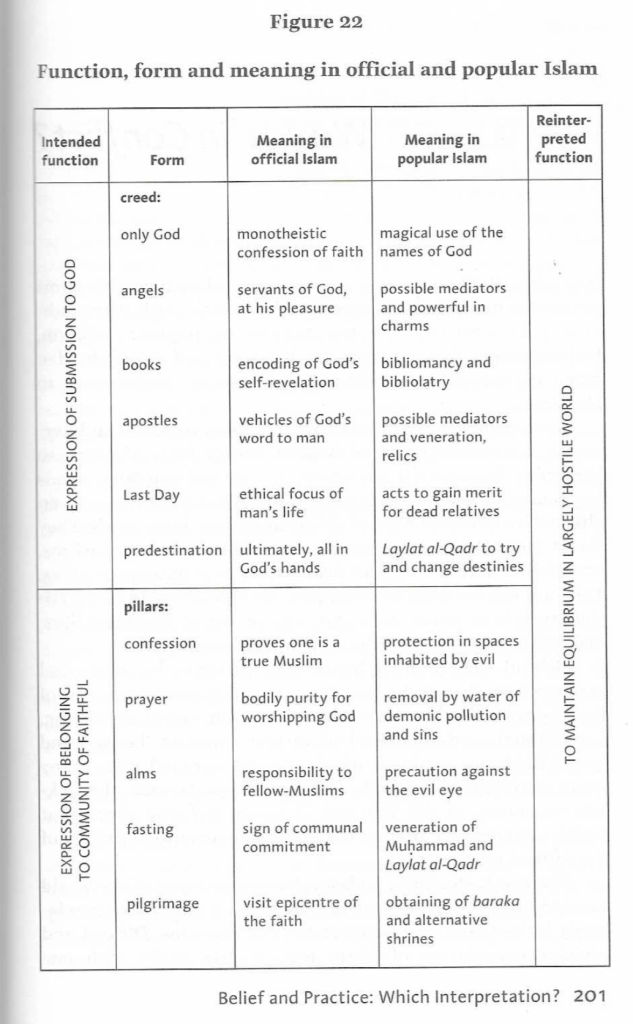
At this point, it is helpful to note that different groups of Muslims use the same forms with different meanings. For example, one Muslim understands the Qur’an to be the source of truth from Allah, while another uses the Qur’an most as a magic book to overcome spiritual forces in their life. Many Muslims simultaneously use the Qur’an in both of these ways. In the chart below, Bill Musk compares the meaning of various forms in official versus popular Islam.[3] Musk uses the term official similar to how I use the term orthodox and popular how I use folk. 

Function, Form, and Meaning in Official and Popular Islam. Scan from Bill Musk, The Unseen Face of Islam: Sharing the Gospel with Ordinary Muslims at Street Level (Oxford: Monarch Books, 2003), 201. 

Studying this chart can provide a significant understanding of the worldview of folk Muslims in South Asia. For example, in orthodox Islam, reciting the confession (i.e., the Shahadah, “there is no God but Allah and Muhammad is his prophet”) proves that someone is a Muslim. However, in folk Islam, the Shahadah is recited as a ward against evil spirits and powers. 

In the same way, Musk described the orthodox view of the Qur’an as “encoding of God’s self-revelation.” Orthodox Muslims believe that reading and understanding the Qur’an gives an understanding of what Allah chose to reveal to His people. Evangelical Christians approach the Bible in a similar manner. However, for folk Muslims, Musk lists bibliomancy and bibliolatry as the uses of the Qur’an. Bibliomancy is what is described in this lesson, using the Qur’an as a magic book. Bibliolatry is the act of setting up the Qur’an as a sort of idol for veneration. Because of the view that the Qur’an holds so much spiritual power, bibliolatry is common among folk Muslims. Bibliolatry is expressed by the Islamic use of images of the Qur’an.

At this point, one barrier to making disciples of South Asian folk Muslims is apparent. As folk Muslims come to Christ, we have to teach them to approach the Bible in a very different way than they have learned to approach the Qur’an. As many folk Muslims come to Christ, it is a strange experience for them that we expect them to read and understand the Bible for knowledge about God’s will. Many folk Muslims are illiterate or functionally illiterate, so a general lack of education complicates the issue. In the face of these issues, great effort and time is required to help followers of Jesus from folk Muslim backgrounds become biblically literate.  

If you found this article helpful, click below to read all of my articles on Folk Islamic rituals. https://nocousinsleft.com/2022/10/18/folk-islamic-rituals/


[1] Moulana Abdullah Darkhasti, Solution through Du’aas, translated by Mohammad Bin Ahmad (New Delhi: Islamic Book Service, 2002), 62.

[2] Ibid., 47-50.

[3] See Bill Musk, The Unseen Face of Islam: Sharing the Gospel with Ordinary Muslims at Street Level (Oxford: Monarch Books, 2003), 201.

Folk Islamic Ritual #6: Zikr and the 99 Names of Allah

If you have found this page and you are a Muslim, asalamu alykum! We are happy you are here. The page you have found is for non-Muslims seeking to understand your religion and culture. In the same way, I would like to invite you to learn about Hazrat Isa al-Masih. Please click here to go to a blog post that will share what the amazing Injeel Sharif teaches about Him! https://nocousinsleft.com/2024/11/25/the-message-of-hazrat-isa-al-masih/

This blog post is the sixth in a series on South Asian folk Islam and its rituals. Click here to go to the first of these articles. Understanding the rituals of Folk Islam provides insight into the beliefs and practices of folk Muslims.

In the previous lesson, we began to look at the folk Muslim’s perception of the spiritual realm of curses, magic, and spiritual beings. One way that folk Muslims seek to interact with this spiritual realm is through protective amulets called tawiz. Another common practice is called zikr (Arabic dhikr), which often uses the 99 names of Allah.

The 99 Names of Allah with English transliteration and meaning. Posters like this are common in South Asia.

Zikr is the Urdu word to remember (zikr karna has the same meaning as the Hindi yaad karna). Therefore, zikr is the act of remembering Allah. Almost every Sufi sect has a style of zikr; some of these practices are relatively tame, while others are quite ecstatic. Most Sufis use zikr as a practice to focus their attention entirely on Allah as practice for seeking spiritual union with him. Here is one example of zikr from the writings of a Sufi who came to Christ and became a Methodist bishop in Lucknow, India:

We enter a dimly-lighted room where a number of men are gathered. As we do so a signal is given by a man who appears to be the leader of the assembly and the doors are shut. There is a hush as twelve men form into two parallel lines in the center of the room. The glimmer of a solitary hurricane lamp falls on the dark faces in which only eyes seem to live. The rest of us fall back to the sides of the room. The dhikr is about to begin. With a startling clap of the hands the leader starts swaying from right to left. Very slowly he begins, and the men fall into the rhythm of his swaying. Every time they sway to the left, they call “Hu!” in chorus. “Hu… Hu… Hu…” So the monotonous chant proceeds with at first hardly and perceptible increase in tempo. But gradually the movement of their bodies becomes more rapid and the sound of “Hu! Hu! Hu!” comes faster and faster with crescendo corresponding with the quicker time. At last the excitement becomes so intense that a man there, and a boy here, slip to their knees, still swaying in unison with the others till finally they fall and collapse on the floor. One man goes forward and looks at the faces of these two and leaves them where they lie. Thus course after course of this chanting and swaying beginning from the slower and proceeding to the wild orgy of motion and shouting, proceeds according to the leader’s direction, who brings the whole course to its end by a loud shout of “Hu!” and a wild jerk to the left. Then dead silence prevails, succeeded by the low undertone of prayer in which all who have not fallen unconscious join.”[1]

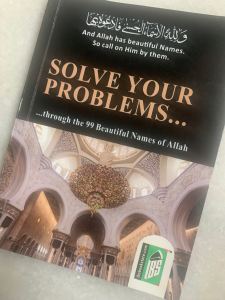
            Probably the most common form of zikr in South Asia is the use of prayer beads called tasbihSome use the tasbih to recite simple phrases like, “there is no God but Allah” (Arabic la ilaha illa llah) repeatedly. For example, if someone wanted to say this phrase a thousand times, they use the tasbih beads to count. Others use the tasbih to recite the 99 names of Allah. Muslims sometimes walk at the park, reciting their prayer beads. Older men sit and recite the names of Allah. A tasbih has 33 beads (some have 99 beads); thus, three cycles are necessary to repeat these 99 names of Allah. In folk Islam, zikr of Allah’s 99 names is a form of obtaining blessing and protection. For example, one little booklet that is commonly available in India lists the particular spiritual benefits of reciting different names of Allah in this manner. For example, 

Prayer booklets like this are available to purchase throughout South Asia.

Al Maliku (The Soverign). A person will become self-sufficient and independent if he reads it excessively daily after Zawaal [mid-day prayers].

Al Qud-doosu (Free from all Blemishes). If recited excessively, Allah will cure the reciter from all spiritual sicknesses.

As Salaamu (The Giver of Peace…). Allah will protect one from all calamities if the Beautiful Name of Allah is read excessively. If recited 115 times and blown on a sick person, Allah Ta’ala will restore his health_Insha-Allah [Arabic “If Allah wills it”].

Al-Mu’minu (The Giver of Peace). Whoever says this Beautiful Name of Allah 630 times in times of fear, Allah will protect him from all calamities_Insha-Allah. If anyone writes in (on paper or by engraving it on a silver ring) and keeps it on him (as ta’weez), his physical and spiritual safety will remain the responsibility of Allah.[2]

            In summary, zikr is a Sufi and folk Islamic practice of remembering Allah. Zikr promotes spiritual union with Allah. As a folk practice, zikr overcomes sickness and gives protection or other blessings. Often, these two goals seem to merge in the lives of Muslims. It is common for Muslims to spend more time in zikr as they increase in age. In South Asia, as people pass into retirement age, this is a time to focus on spirituality. Like tawiz (amulets that contain verses from the Qur’an or names of Allah), zikr is a means for interacting with the spiritual realm that is present around the folk Muslim. 

            These acts reveal that there is a fear-power orientation to the worldviews of folk Muslims in South Asia. Fear-power orientation means that folk Muslims are afraid of spiritual forces that might affect them negatively and are seeking spiritual power to overcome those spiritual forces. In the face of this fear, Scripture tells followers of Jesus, “the one who is in you is greater than the one who is in the world” (1 Jn 4:4). Often, our bold proclamation of the power of Christ who dwells in us by the Holy Spirit is a convincing answer to Muslims’ fear. I have often told my folk Muslim friends that I do not need their amulets and practices because of the power of Jesus that lives inside of me. This declaration often provokes significant spiritual conversation about topics that are meaningful to folk Muslims.

If this post was helpful for you, I encourage you to look at these other posts on Folk Islamic rituals in South Asia. https://nocousinsleft.com/2022/10/18/folk-islamic-rituals/


[1] John Subhan, Sufism: Its Saints and Shrines (Lucknow: Lucknow Publishing House, 1938), 1-2. 

[2] Muhammad Rafeeque, Solve Your Problems through the 99 Beautiful Names of Allah (New Delhi: Islamic Book Service, 2001)9-10.

Pauline Emulation in First Thessalonians

Part of First Thessalonians in Devdu. Devdu is Urdu written in the Hindi script and is a common variant of Urdu in North India.

“You yourselves became imitators of us and of the Lord when, in spite of severe persecution, you welcomed the message with joy from the Holy Spirit.” 1 Thessalonians 1:6


It is my conviction – and that of many missionaries – that missionaries should emulate the apostle Paul in their missionary work.

Paul intended for Timothy to emulate his missionary model, even after his death (2 Tim 3:10-4:8). Paul likewise intended for Timothy to teach others to imitate Paul’s model (2 Tim 2:2). Therefore, Second Timothy teaches us that Paul’s missionary model persists as a model for modern missionaries.

A primary difference between Second Timothy and First Thessalonians is that Second Timothy provides a model for cross-cultural missionaries, like Timothy, to imitate Paul. In contrast, First Thessalonians was written to a local church. Therefore, First Thessalonians focuses on believers in a local church following Paul’s model. 

In this blog post, I want to extend the same argument to First Thessalonians. In 1 Thessalonians 1:6, Paul praised the believers at Thessalonians, saying, “you yourselves became imitators of us and of the Lord when, in spite of great persecution, you welcomed the message with joy from the Holy Spirit.”

The first thing that we see is that there is not a great conflict between imitating Paul and imitating Jesus. The Thessalonians imitated both Jesus and Paul! Elsewhere, Paul wrote, “imitate me as I imitate Christ” (1 Cor 11:1). Some have asked me, “Why focus on emulating Paul instead of Jesus?”

The primary reason we should focus on Paul instead of Jesus is that Jesus was the unique Son of God. As the unique Son of God, there are aspects of His life and mission that we cannot and should not emulate. For example, we should not emulate His sacrificial death for our sins, which was the central act of our salvation. Instead, we stand as witnesses of His unique person and work. In this way, we are more like Paul than Jesus. Paul’s life shows us what aspects of Jesus’ life we should and should not emulate. Thus Paul said, “imitate me as I imitate Christ.” We honor Christ’s unique person and work when we make this distinction.

Returning to First Thessalonians, we see at least four ways Paul expected the Thessalonians to follow his model.

1. Paul praised the Thessalonians for standing firm during persecution, as Paul did.

“You yourselves became imitators of us and of the Lord when, in spite of severe persecution, you welcomed the message with joy from the Holy Spirit.” 1 Thessalonians 1:6

When the church at Thessalonica began, persecution broke out against the church. The church leaders were put on trial for their faith, and the local church had to pay a large sum of money as bail (Acts 17:1-9). Despite these difficulties, the Thessalonians followed the Lord diligently. 

Paul reminded them of how he had “previously suffered and been mistreated at Philippi” (1 Thess 2:2). In Philippi, Paul and Silas were beaten and imprisoned overnight. Despite that persecution, they came to Thessalonica and preached the gospel boldly. Paul was pleased that the Thessalonians likewise stood firmly in Christ despite persecution.

Jesus provided a model for Paul to stand amid persecution. For the joy before Him, our Lord Jesus endured the cross, despised the shame, and sat down at the right hand of the Father (Heb 12:2).

In the same way, following Paul’s model means that we must stand amid persecution. When we stand in persecution, we are not alone.

2. Paul praised the Thessalonians for proclaiming the gospel, as Paul did.

“For the Word of the Lord rang out from you, not only in Macedonia and Achaia but in every place that your faith in God has gone out.” 1 Thessalonians 1:8

Gary Shogren wrote, “ The Thessalonians have come full circle and have become ‘evangelized evangelists.’” (Shogren, 1-2 Thessalonians, page 71). The result of the Thessalonians proclaiming the gospel amid persecution was that the word of God spread quickly across a large geographic area. Specifically, it was reported that the Thessalonians had “turned to God from idols to serve the living and true God and to wait for His Son from heaven” (1 Thess 1:9). 

Imitating Paul means imitating his example in boldly proclaiming the gospel. Paul did not expect every believer at Thessalonica to become a missionary, but he hoped that they would share Christ with their friends, families, and neighbors. Today, some will become like Timothy and imitate Paul by becoming cross-cultural church planters. Others will imitate Paul by working hard in their jobs and proclaiming Christ in every opportunity. The first model is present in Second Timothy. The second model is evident in First Thessalonians. 

3. Paul encouraged the Thessalonians to follow his work ethic.

”Seek to lead a quiet life, to mind your own business, and to work with your own hands, as we commanded you, so that we may behave properly in the presence of outsiders and not be dependent on anyone” 1 Thessalonians 4:11-12

Paul commanded the Thessalonians to work hard with their own hands. Regarding his own example, Paul wrote, “you yourselves remember our labor and hardship, brothers and sisters. Working night and day so that we would not burden any of you, we preached God’s gospel to you” (1 Thess 2:9). The book of Acts reports Paul making tents shortly after his time in Thessalonica (Acts 18:3). By extension, it seems likely that Paul was involved with the same work in Thessalonica. 

Please note that Paul worked hard to provide for his needs while proclaiming the gospel. However, when sufficient funds were available, he left tentmaking to focus on preaching the Word (see Acts 18:5). 

Following Paul’s model means to live a life of diligence and hard work. Working hard with your hands is legitimate, as Paul demonstrated. Paul’s model leaves space for individuals in full-time ministry, bi-vocational ministry, or those engaged in full-time work. All three should work hard, as Paul did. And all three should be diligent in proclaiming the gospel, as Paul did.

4. Paul encouraged the Thessalonians to imitate his spiritual life.

”Rejoice always, pray without ceasing, give thanks in everything, for this is God’s will for you in Christ Jesus.” 1 Thessalonians 5:16-18

Many have agonized over a way to obey the command, “pray without ceasing.” Often unnoticed is that Paul used this same adverb to describe his own prayer life in First Thessalonians. First, he referenced “making mention of you without ceasing in our prayers” (1 Thess 1:2). Then he wrote that “we thank God without ceasing” (1 Thess 2:13). In light of this, we can paraphrase the command “praying without ceasing” as Paul saying, “pray as much as I do.” 

Ministers of the gospel should be able to tell their disciples, “pray as much as I do.” Many are uncomfortable with this statement because they see their weaknesses in their prayer lives. Brothers and sisters, this is the most critical part of imitating Paul. We must love God with great zeal. We must pray constantly. We must abide in Jesus. We must keep in step with the Spirit. Paul provided a powerful model in his spiritual life for the Thessalonians until he could say, “pray as much as I do.” 

Likewise, we should each go and pray as much as we desire our disciples to pray.

Therefore, every follower of Jesus should imitate Paul by standing firm during persecution, proclaiming the gospel, working hard, and praying without ceasing. Some will be called out as cross-cultural missionaries. But when the average believer lives in the way that Paul expected n First Thessalonians, the kingdom advances through them. Living in South Asia, I have the joy of serving alongside South Asian brothers and sisters in Christ who live out these characteristics. No doubt that is part of the reason that the gospel is advancing so quickly in this region of the world.

Folk Islamic Ritual #5: Tawiz (Amulets)

This blog post is the fifth in a series on South Asian folk Islam and its rituals. Click here to go to the first of these articles. Understanding the rituals of Folk Islam provides insight into the beliefs and practices of folk Muslims.

Boy wearing a taweez with Allah written on it. Taken from https://www.bbc.com/news/uk-england-manchester-37160729

For some, it is strange to explore the worldview of folk Muslims. Many people think of Muslims as being stoic orthodox people who study and obey the Qur’an similarly to how evangelical Christians study and obey the Bible. Within Islam, there are vast numbers of Muslims who do follow orthodox Islam (click here for a discussion on three poles of South Asian Islam). However, the influence of Islamic folk practices on ordinary Muslims is profound and often overlooked. This lesson continues a look at folk Islamic practices by looking at tawiz (sometimes pronounced tabiz).

Tawiz are amulets that are commonly worn by Muslims in South Asia. Tawiz are black boxes on a black string that contain either written verses of the Qur’an, names of Allah, or prayers (Urdu dua). Similar amulets were used in Judaism, as seen in Matthew 23:5, where Jesus accused the scribes and Pharisees of enlarging their phylacteries to be seen by others. As with Muslims, the Pharisees used these as protective amulets that contained verses from Scripture or prayers. Making tawiz is a crucial function of spiritual leaders among folk Muslims.

 A Hadith reports that Muhammad offered short prayers or recited verses from the Qur’an and then breathed on those for whom he recited these prayers. His companions did the same and begin writing these prayers or verses on paper and making tawiz. Now, tawiz exist for almost every purpose. For example, when my friend Muhammad began to follow Jesus, he did not have a job. So, his mother went to a dargah and had a tawiz made by her pir (click here to learn about Pirs and dargahs). Muhammad did not know what to do because he had not told his parents about his decision to follow Jesus. His mother was seeking a meeting with him to tie the tawiz on him, but he knew that he could not do this as a follower of Jesus. For Muhammad’s mother, the tawiz was a practical and powerful expression of her Islamic faith.

It is helpful to see how the tawiz relates to ordinary Muslims’ understanding of how the world works. There is a famous article by Paul Hiebert called “The Flaw of the Excluded Middle.” Hiebert’s premise was that many Westerners have a hard time understanding animistic or folk cultures. Westerners have a low perception of invisible spiritual forces and powers that are at work all around us. South Asian folk Muslims tend to have a heightened focus on spiritual forces and powers that are all around us. Westerners tend to focus on science and scientific answers to issues and problems. Folk Muslims often believe spiritual forces are at work in situations where a Westerner would apply scientific principles. Hiebert said that evangelical Christians often focus on the scientific and the eternal, such as heaven and hell while excluding the present spiritual forces at work in our day to day lives, thus the flaw of the excluded middle.

In The Unseen Face of Islam, Bill Musk applied Hiebert’s principle to folk Islam and developed the following chart.[1]

Cosmology of Popular Islam. Scan from Bill Musk, The Unseen Face of Islam: Sharing the Gospel with Ordinary Muslims at Street Level (Oxford: Monarch Books, 2003), 174. 

Studying this chart helps us understand how folk Muslims perceive the world around them. On the left side are the words “this-worldly realm” and “other-worldly realm.” This-worldly realm means those being and powers that are around us at all times. In contrast, the other-worldly realm is distant and separate from us. On the right side are the terms “empirical phenomena” and “trans-empirical phenomena.” By empirical, Musk means what can and cannot be scientifically measured or observed. Animals, plants, and drugs can be scientifically observed and measured. Magic, curses, and spiritual beings cannot be scientifically observed and measured. For many folk Muslims, those things that are “this-worldly” and “trans-empirical” are the actual controlling forces in the world. These powers and beings exist in what Hiebert calls “the forgotten middle.” 

The use of tawiz in South Asia is one example of a spiritual cure. It is an attempt by “living holy men” called pirs to provide spiritual power to their followers in the form of an object to ward of unseen spiritual forces, such as the evil eye, jinn, or magic. Often when a folk Muslim is sick, has a bad crop, has an accident, or loses their job, the source of their bad fortune is assumed to be unseen spiritual forces rather than scientifically observable causes. 

Therefore, when ministering to folk Muslims, the “excluded middle” cannot be neglected. One of the most practical ways that Christians can minister is to seek for specific prayer requests from Muslim seekers and to pray for those requests. A folk Muslim will rarely refuse prayer from a Christian. As we pray, we demonstrate to Muslims the kind of relationship that we have with God. Often after praying for a Muslim, they are startled and tell me that they can see that I actually know God. As we continue to pray, we hope that God will show His power in the life of folk Muslims and answer these requests as a way of opening their hearts to the gospel.

There is some controversy about how to pray for Muslims. Some argue that we should follow the formulaic bismillah approach in prayer that Muslims often use. These prayers begin with the formulaic “In the name of Allah, most gracious, most merciful” that starts almost every Surah of the Qur’an. In contrast, I want to pray for my Muslim friends in the name of Jesus. To do this, I usually inform a Muslim that I am about to pray for that I am a disciple of Jesus. Therefore, I will pray for them in the way that Jesus taught His disciples. Then I begin with something like, “Our Father who lives in heaven” or “Father God.” I generally finish my prayers by saying, “I pray this through (Urdu ke vasile se) Hazrat Isa al-Masih. Amen.”

If you found this article helpful, click below to read all of my articles on Folk Islamic rituals. https://nocousinsleft.com/2022/10/18/folk-islamic-rituals/

Subscribe to get updates from our blog!


[1] See Bill Musk, The Unseen Face of Islam: Sharing the Gospel with Ordinary Muslims at Street Level (Oxford: Monarch Books, 2003), 174.

Sharing Jesus with South Asian Shias

When Islam first spread to South Asia, it spread through Shia Muslims, first to the Sindh and then to the area around Lucknow. The father of Pakistan, Muhammad Ali Jinnah, was a secular Shia.[1] Today, Pakistan and India have significant Shia populations of at least 20 million per country.[2] Despite this large population, there are almost no gospel workers focused on South Asian Shias.

The purpose of this blog post is to help readers understand South Asia Shia Muslims to better share the good news of Jesus with them.

An artistic rendering of the Panchtan Pak. At the center is Allah. Top center is Muhammad then clockwise, the names Ali, Hasan, Husayn, and Fatimah (in Arabic). Symbols like this for the Panchtan Pak are common among Shia Muslims.

The Panchtan Pak[3]: Muhammad, Fatimah, Ali, Hasan, and Husayn

Go to an imambara (a South Asian Shia house of worship). You will see five names written in Arabic script, often in various banners, around the imambara. Those five names are Muhammad, Fatimah, Ali, Hasan, and Husayn. The significance of these five figures cannot be underestimated for Shias. Here are some brief details about each of the five:

  • Muhammad (570-632 AD). The prophet of Islam.
  • Fatimah (d. 632 AD). Daughter of Muhammad, wife of Ali, and mother of Hasan and Husayn. Often considered the ultimate Muslim woman, especially among Shias. Shias view Fatimah with a similar reverence that Catholics have for Mary.
  • Ali (d. 661 AD). Cousin of Muhammad, husband of Fatimah, father of Hasan and Husayn. Served as the fourth rightly guided Caliph from 656-661 AD. Ali is considered the first Imam by Shia Muslims. The teachings and writings of Ali are collected in the Nahjul Balaghah, which is a book of significance for Shia. When Ali became Caliph, a civil work broke out among Muslims, during which Ali was killed. The death of Ali signified a decisive split between Sunnis and Shias in 661 AD. 
    • The first three rightly guided Caliphs were (1) Abu Bakr (632-634 AD), (2) Umar (634-644 AD), and (3) Uthman (644-656 AD). Most Shias believe that Ali should have been the leader of Islam during the period these other men led. 
  • Hasan (d. 670 AD). Grandson of Muhammad, eldest son of Ali and Fatimah. Shias consider Hasan to be the second Imam. Most believe Hasan was poisoned at the direction of Mu’awiya. Mu’awiya became the Caliph of the Umayyad Caliphate, which was formed after the death of Ali. 
  • Husayn (d. 680 AD). Grandson of Muhammad, second son of Ali and Fatimah. Shias consider Husayn to be the third Imam. Husayn was one of 70 men attacked by 4,000 Umayyad troops in the Battle of Karbala. The Umayyads attacked when Husayn refused to submit to Mu’awiya’s authority. Husayn’s death is considered sacrificial by the Shia community and is remembered in the annual Muhurram celebrations. Husayn’s tomb at Karbala is Shias’s most important pilgrimage site today. 

Adoration of the Panchtan Pak is central to Shia thought.[4] For example:

  • Shias believe that the Panchtan Pak were without sin and infallible in their teaching.
  • Many Shias believe that the Panchtan Pak were created before Adam before the foundation of the world. The five are often considered the hand of Allah, through whom Allah made the world. In this view, they existed as mystical lights and later came into the world.
  • For Shias, Muhammad was the last and greatest prophet, and therefore, Muhammad’s life and teaching are central. However, a common phrase among Shias is, “Live like Ali; die like Husayn.” As a result, the lives and teaching of all the Panchtan Pak are of central importance. Shias find great importance in reading the Nahjul Balaghah, which contains the teachings and writings of Ali.
  • Fatimah is considered the ideal Muslim woman who connects the rest of the Panchtan Pak.
  • Husayn’s death is the focus of Muhurram, which is the most important Shia celebration., Husayn’s tomb in Karbala is a focus of worship and pilgrimage among Shias.

The Imamate

Most Shias in South Asia are Twelvers, although the Nazari’s of Pakistan are also a significant community. Twelvers believe in Twelve Imams. The Twelve Imams are:

  1. Ali, son-in-law of Muhammad (d. 661 AD)
  2. Hasan, son of Ali (d. 670 AD)
  3. Husayn, son of Ali (d. 680 AD)
  4. Ali, son of Husayn (d. 712 AD)
  5. Muhammad, son of Ali (d. 732 AD)
  6. Ja’far, son of Muhammad (d. 765 AD)[5]
  7. Musa, son of Ja’far (dd. 799 AD)
  8. Ali, son of Musa (d. 817 AD)
  9. Muhammad, son of Ali (d. 835 AD)
  10. Ali, son of Muhammad (d. 868 AD)
  11. Hasan, son off Ali (d. 874 AD)
  12. Muhammad, son of Hasan (b. 870 AD). Called al-Mahdi by Shias and considered still alive in hiding until the end times, when he will come with Jesus as the deliverer of Shia Islam and bring justice to the world. The al-Mahdi disappeared in 878 AD and has communicated through intermediaries since.

Waiting for the al-Mahdi to come in the last days is central to religious Shia Muslims. Their end-time view of the al-Mahdi coming to bring justice is like the Christian view about the second coming of Jesus. In the Shia view, Jesus will also come in submission to the al-Mahdi.

In remembrance of the Imams, Shias in South Asia gather in imambaras, especially during Muhurram.[6]Imambara derives from a Persian term for “house of the Imams” and is a place to revere the Panchtan and the Twelve Imams. Imambaras generally house replicas of the tomb of Husayn that are called Taziah.[7] In Lucknow, Uttar Pradesh, two famous Imambaras are now tourist attractions.


Shia and the Muslim Triangle

Shias can be understood through the Muslim triangle. Three poles affect the average Shia: orthodox Shia Islam, Sufism and folk Islam, and secularism. Click here for more information on the Muslim Triangle.

  • Orthodox Shia Islam. Most Orthodox Shias focus primarily on Muhammad and the Qur’an. Many Christians will not even realize that they are talking to a Shia until later since many beliefs of Shias and Sunnis are similar. Orthodox Shias tend not to want to talk about the Panchtan and other issues until the question of Muhammad and the Qur’an is settled. 
  • Folk Shias and Sufis. Historically, many Sufis in South Asia were Shia. Kwaja Moinuddin Chishti, whose tomb is in Ajmer, Rajasthan, India, was a Shia. The reason is that Shias give great respect to the family lineage of Muhammad. There is a caste of Muslims called the Sayyid in South Asia that claim to descend from the tribe of Muhammad. Most of the original Sufis that preached Islam in South Asia were Sayyid and claimed descent from Muhammad as part of their authority. In Sufi Islam, a silsila that traces a spiritual ancestry from Muhammad through Ali is essential. As a result, folk Islam is strong in Shia Islam in South Asia and has many expressions. Many folk Shia give great respect to the Panchtan.
  • Secularism and Shias. At the same time, many Shias are hard-working and secular-minded. Shias have put a significant emphasis on secular education with the result that many Shias are intelligent and open-minded. Because of their education and open-mindedness, many Shias are happy to read the Injeel (New Testament) and have open conversations about the gospel.

Tips for Evangelism

  • Muhurram as an open door for friendship. Shias love outsiders to come and learn about their faith, especially during Muhurram. If you want to build inroads among Shias, find when Muhurram is and make plans to visit your local Shia community. Go ready to learn and listen, but also to appropriately share about your own faith. Muhurram is an excellent opportunity for building friendships.
  • The martyrdom of Husayn and the death of Jesus. The centrality of Husayn’s martyrdom is mirrored in our faith with the death of Jesus. Do not be surprised if a Shia interjects with this story when you share the gospel. Likewise, suppose your Shia friend shares about the death of Husayn. In that case, it is an appropriate time for you to ask if you can share about the sacrificial death of Jesus and what it means for you. In my experience, our gospel presentation also functions well among Shias. Click here for a blog post on that tool.
  • The Panchtan Pak and the preeminence of Jesus. The Panchtan Pak are a significant barrier to Shias understanding the gospel. Their minds will automatically compare Jesus with these five as you share. The Five Special Things about Jesus are a great tool to use with Shias to demonstrate the uniqueness and greatness of Jesus. The Five Special Things are: (1) His birth, (2) His miracles, (3) His teaching, (4) Hiss death, and (5) His resurrection. These five things are part of our gospel tool (click here).
  • Because Shias are a smaller community, they tend to be non-violent. Shias in South Asia are often the victims of attacks by Sunnis but rarely attack other communities. They want peace with others and are very open to religious discussions.
  •  Last, pray for your Shia friends!

Subscribe to No Cousins Left to receive updates from each our blog posts!


[1] Jinnah famously converted from Ismaili Shia Islam to being a Twelver Shia to avoid conflict control by the Aga Khan.

[2] Research on the number of Shia per country is weak. After Iran, Pakistan and India may have the second and third largest Shia populations. However, the Shia population in Iraq is similar. Iran has the largest Shia population in the world.

[3] Panjtan Pak is the South Asian name for these five figures and derives from Persian. In Arabic, they are called Ahl al-Kisa.

[4] Note that multiple Shia Islam schools do not agree about their nature. What is written here is from my experiences interacting with South Asian Shias.

[5] Another Shia Muslim sect called Ishmailis holds that Ishmael, son of Ja’far (d. 775 AD), was the seventh and last imam.

[6] Shias build imambaras in South Asia, but most Shias globally do not use them. 

[7] Taziah is also used in reference to plays about the martyrdom of Husayn that are common during Muhurram. 

Five Barriers to Engaging Muslims with the Gospel

A pulpit inside of an imambara, a Shia place of worship.

In 1791, William Carey published An Enquiry, effectively launching the modern missions movement. His argument was that Christians needed to take up the Great Commission by forming mission boards to launch missionaries to the nations. Carey led the charge by going to India in 1792. In An Enquiry, Carey detailed the greatest centers of lostness in the world, making special note of a sizeable Muslim population that had not heard the gospel of our Lord Jesus (Carey, 62, 64). 

Now, 230 years later, Muslims remain one of the most significant challenges in the global advance of the gospel. There are over two billion Muslims worldwide, with South Asia having the greatest concentration of Muslim lostness. Most Christians are unprepared to take the gospel to their Muslim neighbors despite the need. 

The barriers that stop Christians from loving their Muslim neighbors are less about issues within the Muslim community and more about our hearts. The most significant obstacles preventing Christians from ministering to Muslims are heart issues. Until these heart issues are appropriately addressed, there is no benefit in training them to share the gospel with Muslims. Therefore, the purpose of this blog post is to help Christians identify and address the heart issues that inhibit them from being used by God to reach Muslims.

The first three barriers (Fear, Anger, and Hopelessness) are heart issues. The last two barriers (language/culture and lack of ministry tools) are what training can provide. 

Heart Barrier #1 – Fear. Many Christians are afraid of Muslims, and therefore, they will not go to them to share the gospel.

Let me share a common experience that I have had. It is common that when I train a group of people how to share the gospel with Muslims, I can see their hearts close as I teach. Smiles turn into frowns, and arms become defensively crossed. 

Inside the minds of my listeners, there is often a dialogue that goes something like this: “Doesn’t this guy know that Muslims are dangerous? If we go and try to do what this guy says, we’re going to get killed! We can’t go talk to Muslims about Jesus!” 

I call this inner dialogue the fear barrier. Fear is the strongest barrier that keeps Christians from talking to Muslims about Jesus. Here are four ways that the fear barrier can be dispelled.

  1. Trusting in God to protect us. My favorite verse on this subject is “Do not fear, for I am with you; do not be afraid, for I am your God. I will strengthen you; I will help you; I will hold on to you with my righteous right hand” (Isaiah 41:10). In fact, the most common command in Scripture is, “Do not fear.” Ultimately, we do not need to fear when doing God’s will because He is our defender. He will protect us.
  2. Remember that “to live is Christ and to die is gain” (Philippians 1:21). Even though God is our defender, it does not mean that we will not die while doing His work. Jesus was crucified while teaching God’s Word. Likewise, almost all His apostles died violent deaths for proclaiming the gospel. While Paul awaited execution in Rome, he wrote, “The Lord will rescue me from every evil work and will bring me safely into His heavenly kingdom” (2 Timothy 4:18). While expecting to die physically, Paul trusted God to safely bring him into His kingdom. The gospel means that we have no fear of death. Even if we were to die while proclaiming the gospel, we are taken immediately into the presence of our God.
  3. Knowing that Muslims are without eternal hope. In contrast to our hope, if our Muslim neighbor dies today, then they go before the judgment seat of Christ (Heb 9:27). They are without hope in His judgment. If we truly believe the gospel, our eternal future is secure in Christ! How we can withhold this message that brings eternal hope from those who have never heard (Rom 10:9-15). 
  4. Realizing that most Muslims are peaceful people. While many Christians believe that Muslims are violent people, the reality is that most Muslims simply want to live peaceful and quiet lives. In fact, the number of Muslims who seek to express their religion violently is minimal when we consider Muslims in South Asia. For this point, the Muslim Triangle is helpful. Secular and folk Muslims, as a rule, are not violent in their faith. Since folk Islam is the most common expression of Islam in South Asia, we know that ordinary Muslims in South Asia tend to be non-violent. In addition, most of the major orthodox Muslim groups in South Asia reject violence in the name of Islam.[1] Therefore, we can have confidence that most South Asian Muslims desire to live peaceful lives.[2]
To learn more about the Muslim triangle, click here!

Heart Barrier #2 – Anger. Many Christians are angry with Muslims, and therefore, they do not want to share the gospel with them. For some, anger is not the right word. Instead, bitterness or animosity would be more appropriate. What I mean is that many Christians see Muslims as other than themselves and do not have a love for their Muslim neighbors. One good biblical picture of this animosity is the prophet Jonah. God sent him to proclaim a message of repentance and forgiveness to Nineveh, who were the enemy of his people. Because Jonah hated the people of Nineveh, he sought to disobey by traveling the opposite direction from Nineveh. Likewise, many Christians are not ready to share the gospel with Muslims because they do not have the love of Christ for Muslims.

However, Jesus died for Muslims, just like He did for everyone else. Revelation 5:9 praises Jesus, saying, “You purchased people for God by Your blood from every tribe and language and people and nation.” It is clear, from this verse, that Jesus died for every type of person on the planet, including every Muslim people group. Therefore, God loves Muslims! 

If God loves Muslims and we do not, our hearts are not like God’s. So, we need to ask God to transform our lives, and we should ask God to give us His love for Muslim peoples!

Jesus taught us that there is no benefit of only loving people like us. In fact, He taught us to love our enemies (Matthew 5:43-47). Therefore, if you feel in your heart that Muslims are your enemy, then your biblical obligation is to love them. Let me suggest that you pick a Muslim group or country and pray daily for that group to begin loving them. As you pray for them, God will undoubtedly change your life and help you love them as He loves them.

Finally, Jesus provided the best model of loving those who did not love Him. When He was being crucified, He said, “Father, forgive them because they do not know what they are doing” (Luke 23:34). To be like Jesus means to have a heart ready to forgive others, even if they were killing you. In fact, Stephen followed the same example when he died for proclaiming the gospel and was the first martyr in the book of Acts. As he died, he said, “Lord, do not hold this sin against them!” (Acts 7:60)

Heart Barrier #3 – Hopelessness. Many Christians do not believe Muslims can come to Christ, and therefore, they do not think it is worth it to minister among them. Perhaps my favorite story about this issue is a friend whose father was a Muslim-background believer. He was unwilling to share the gospel with his Muslim neighbors despite his background. He would tell me, “It is impossible for a Muslim to come to Christ!” I kept reminding him about how the Lord drew his father to Christ, so he said, “It is very difficult for Muslims to come to Christ.” 

So, I asked him how long it had been since he had shared the gospel with a Muslim, and he admitted that it had been more than ten years. So, finally – perhaps even just to make me quiet – he agreed to try. A few weeks later, this same man excitedly told me how he had shared the gospel with one Muslim man and how that man had repented and believed!

Sometimes, Muslim ministry is slow. However, the Lord is in control. If we say that Muslims can’t come to Christ, we are really saying that Muslims are the one people group on earth strong enough to resist God’s will! Our God made the heavens and the earth. He brought His people out of Egypt through Moses. He raised Jesus from the dead. Our God can do all things! Perhaps the greatest antidote to the hopelessness barrier is to meet Muslims who have come to Christ and hear their stories. In fact, more Muslims are coming to Christ now than at any other time in history. Across South Asia, many thousands of Muslims are coming to Christ. Also, significant movements of Muslims to Christ have happened in countries like Indonesia, Ethiopia, Algeria, and Iran. If you want to learn more about Muslims coming to Christ, I recommend reading David Garrison’s A Wind in the House of Islam.

Summarizing the Heart Barriers

Suppose the three heart barriers of Fear, Anger, and Hopelessness are not addressed. In that case, no amount of training about reaching Muslims with the gospel will be effective. The question is, are you ready to let God change your heart? Are you prepared to love Muslims and work among them? Our God has a great desire to bring Muslims into His kingdom, and he is ready to use you if your heart is ready to be soft towards Him. Please stop now and pray that God will take away your Fear, Anger, and Hopeless. Ask that He will replace it with His love for Muslim peoples.

Now that we have addressed the three heart barriers, we can briefly discuss the last two barriers. These are practical barriers that can be given in training settings.

Barrier #4 – Language and CultureTo communicate the gospel with Muslims, we should learn some language and culture. I am going to give advice for multiple settings here.

  • For those serving among Muslims in the West. To start your work, you don’t have to learn a Muslim language (but you may want to after some time!). In fact, you probably serve among Muslims who speak multiple languages. It is not practical or possible for you to learn all these languages. However, it will be helpful for you to learn some critical Arabic phrases and some Muslim culture. A great first step would be to read Nabeel Qureshi’s Seeking Allah, Finding JesusYou will discover how a Muslim in the West perceives the West and some key Arabic phrases that most Muslims use. Also, begin by learning one Arabic term, assalamu alaikum. This is the most common greeting for Muslims around the world. Whenever you see someone you think might be a Muslim, simply say this phrase with a smile. No doubt, you will build many relationships!
  • For expatriate workers in South Asia. Work diligently to master at least one local language! One of my most joyful tasks is to disciple Muslim-background believers in Urdu, digging through the Bible with them. As my ability to speak Urdu increases, my usefulness to local believers increases. Please do not disregard language study! 
  • For South Asian Christians. Many Christians speak in Hindustani (India) or Urdu (Pakistan) that is very different from the Urdu that Muslims use. Therefore, the gospel is misunderstood when they share it with Muslims. South Asian Christians can learn how to speak in a Muselmani version of their language with minimal effort. 

Barrier #5 – Lack of Ministry Tools. Many Christians do not know how to communicate the gospel with Muslims or disciple those ready to believe. Thankfully, we are beginning to add more and more tools for this to our blog! 


[1] For example, Deobandis and Tablighi Jamaat tend towards non-violence and are two of the largest orthodox schools of Islam in South Asia. However, it has been noted that those few Muslims who have become extremists first became orthodox, often through the Deobandis and Tablighi Jamaat movements. They then take the next step into violent extremism. In fact, some have mistaken these two movements as advocating extremism because most terrorists from Muslim backgrounds in South Asia have been influenced by one or both schools.

[2] In South Asia, sectarian violence between religious communities can sometimes make whole communities appear violent. The prime example was the violence between Hindus and Muslims during Partition. During that period, both communities killed large numbers of the other community. This sectarian violence between religious communities is different from Muslims, who are violent for pursuing religious goals. In fact, a significant amount of this religious violence is because something disturbs the communal peace, resulting in violence from both communities.